When purchasing LED lighting fixtures, especially high power LED lights like outdoor LED floodlights, LED Street lights, and LED highbay lights for large-scale engineering projects, many people overlook the THD (total harmonic distortion) value among the numerous LED lighting specifications, such as CRI, Color Temperature, Power Factor, Beam Angle, IP Rating, IK Rating, Illuminance, Luminous Flux, and THD. In fact, many LED light manufacturers in China don’t even include THD in their datasheets. However, the harmonic distortion requirements for LED lighting fixtures are important technical indicators in the field of electrical engineering, directly affecting power grid quality and electrical safety.
What is the THD of LED lights?
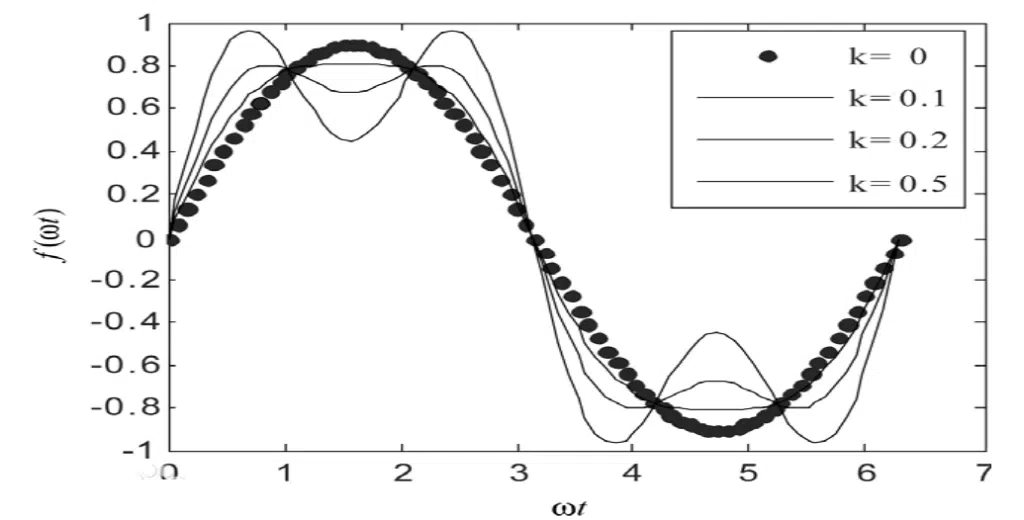
Harmonic content is the proportion of different frequency harmonics in an alternating current signal relative to the fundamental frequency, usually expressed as total harmonic distortion (THD). Its generation arises from non-sinusoidal current distortion caused by nonlinear loads in the power system, with odd harmonics (such as the 3rd, 5th, and 7th) dominating in a balanced three-phase system.
When an LED light is working, its internal circuitry may generate abnormal current fluctuations (i.e., harmonics). These fluctuations are like abnormal vibrations in a water pipe, which may affect the normal use of other electrical appliances (such as televisions and stereos), and may even increase electricity bills or shorten the lifespan of the equipment.
The total harmonic distortion (THD) of LED lights can be simply understood as the degree of “pollution” they cause to the power grid. The lower the value, the safer and more stable the power supply.
Why pay attention to the THD of LED lights?
In the LED lighting industry, when using low THD (Total Harmonic Distortion) LED lighting products, the potential harm may not be apparent if these LED lights’ wattages are lower than 50W, like 7W 10W, 12W, 15W, 20W, 30W,40W, etc or are used in small quantities. However, once these products are used intensively and in large quantities, the total harmonic current they generate can pollute the entire power supply system and other electricity users.
- Power Grid Impact: Harmonics cause voltage waveform distortion in the power grid, increase transmission line losses, and reduce the overall efficiency of power generation and transmission equipment.
- Equipment Interference: Nearby electronic equipment may experience display abnormalities (such as snow), communication noise, or even trigger malfunctions in protection devices, threatening the stability of the power system.
How to reduce the THD of LED lights?
- Improving the LED driver: LED driver power supplies are a major source of harmonic currents. Improving the design of the driver power supply can effectively reduce the generation of harmonic currents. For example, using an efficient power supply topology and selecting appropriate power supply components can help. In addition, appropriately selecting the capacity of the driver power supply and avoiding over-supply is also an effective way to reduce harmonic currents. Only using the LED lights, which is lower than 15% in THD.
- Using harmonic filters: Harmonic filters are effective devices for controlling harmonics. They can filter out harmonic currents and reduce pollution to the power grid by selecting appropriate frequencies and capacities. However, harmonic filters are relatively expensive and require a certain amount of space, so a trade-off must be made in practical applications.
- Optimizing lighting loads: The nonlinear characteristics of LED lighting loads amplify the impact of harmonic currents. Therefore, optimizing the structure of lighting loads is a crucial step in mitigating harmonic currents. By rationally designing the circuitry and electronic components of the lighting load and reducing nonlinear characteristics, the generation of harmonic currents can be decreased.
How to select the correct THD of LED lights?
Generally, low-power LED lights, such as LED downlights and spotlights, do not have very high requirements for THD when used in residential lighting. But for high-power lights for commercial or industrial areas, we have to be careful.
- Industrial Lighting: When inverters, motors, and other equipment in factories share the power grid with LED lights, harmonic levels may reach over 50%. Filters must be installed, or low-harmonic lighting fixtures in THD must be selected.
- Commercial Lighting, like 600×600 LED panel lights, 50W LED downlights, etc, In shopping malls, office buildings, and other similar locations, the simultaneous use of numerous LED lights can lead to harmonic superposition. Lighting fixtures with a THD of ≤15% should be selected to avoid grid pollution.
- Street Lighting: Outdoor LED streetlights must meet IP65 protection standards, and harmonic control must comply with the power grid company’s requirements of <15%, even <10%; otherwise, grid connection acceptance may be affected.
How many LED lights are needed to generate THD?
Answering this question requires more than a fixed number. The factors contributing to harmonics include not only the number of LEDs but also their power, quality, circuit design, and the operating environment. Generally, when multiple LEDs operate simultaneously, their harmonics can overlap, increasing their impact. However, if the LED circuitry is well-designed and of high quality, even a large number may not necessarily cause severe harmonic problems.
In practical applications, we typically determine the presence of harmonics through measurement and analysis. For example, a harmonic analyzer can be used to detect the harmonic content in the power grid, and appropriate measures can be taken to reduce its impact based on the results. Therefore, a more accurate answer to the question of how many LEDs are needed to generate harmonics is to analyze and determine the specific situation.

Hello, customers
My name is Ricky Wang, I’m the business manager of GRNLED. I have been in LED lights industry for more than 10 year. Feel free to contact us. I’m happy to provide you the best service and products.
Email: info@grnled.com | WeChat: ledfixture