How to select the solar street lights: 3.2V, 12.8V or 25.6V system?
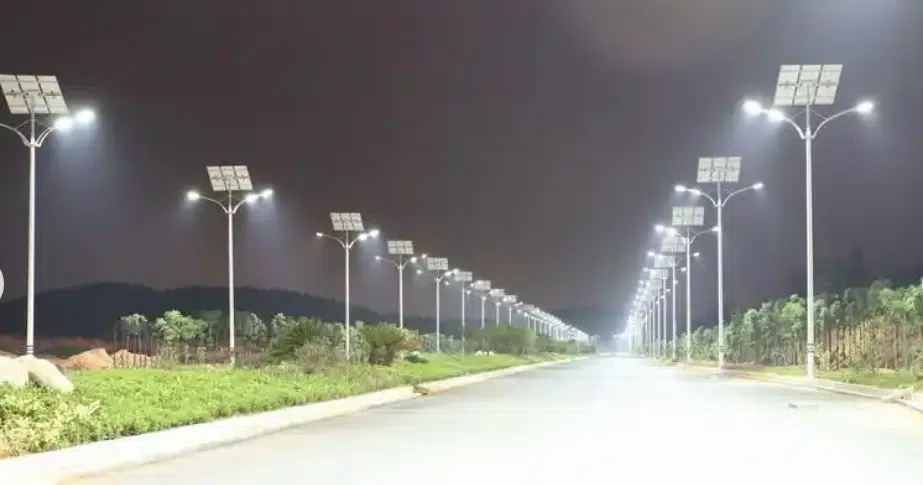
Solar streetlights operate on different voltage systems, especially integrated -all in one solar streetlights. Before searching for suitable solar LED street lights, it’s essential to understand the differences between these various voltage systems to avoid making mistakes.
The Key Difference
The three systems are essentially different series/parallel configurations of the same LiFePO₄ (Lithium Iron Phosphate) cells
| Voltage | 3.2V | 12.8V | 25.6V |
|---|---|---|---|
| Series configuration | 1S (single cell) | 4S (4 cells) | 8S (8 cells) |
| Full-charge / cut-off voltage | 3.65V / ~2.5V | 14.6V / ~10V | 29.2V / ~20V |
| BMS complexity | No balancing, simple protection board | Balancing required | Highest balancing requirement; cell consistency is critical |
| Typical cell capacity | 10–60Ah | 15–80Ah | 15–60Ah (e.g., 25.6V/50Ah) |
Key Comparison
1. Current and Cable Loss (the most critical engineering difference across all three)
| Solar street light voltage | 3.2V | 12.8V | 25.6V |
|---|---|---|---|
| Operating current (100W) | ~31A | ~7.8A | ~3.9A |
| Cable heating / loss | High, needs thick wire | Moderate | Minimal |
The higher the voltage, the lower the current, the lower the cable loss and heat, and the more stable the system — which is the fundamental reason high power requires higher system voltage.
2. Maximum Power and Applicable Scenarios
| 3.2V | 12.8V | 25.6V | |
|---|---|---|---|
| Recommended power | ≤60W | 60–100W (up to 130W) | 120–200W+ |
| Pole height | 4–6m | 6–12m | 10–15m (high-mast) |
| Typical applications | Rural roads, courtyards, low-budget projects | Municipal roads, industrial parks, schools | Highways, national roads, expressways, high-mast lighting |
Industry practice: above 60W, the 3.2V system’s current becomes excessive and efficiency drops; above 60W it is recommended to go straight to 12.8V or higher voltage. Common 25.6V configurations include 25.6V/45Ah (1152Wh) paired with a 60–80W lamp and 180W panel, or 25.6V/60Ah (1536Wh) paired with an 80–100W lamp and 280W panel.
3. Solar Panel Matching
| Solar powered street light voltage | 3.2V | 12.8V | 25.6V |
|---|---|---|---|
| Panel specification | 6V-class | 18V-class (36-cell) | 36V-class (72-cell) |
| Controller | Low-voltage/boost | Usually MPPT | MPPT mandatory, higher power |
4. Efficiency and Reliability
- There is a general industry consensus: the higher the battery voltage, the higher the conversion efficiency and the better the reliability; the 3.2V system incurs greater two-stage conversion losses when boosting to drive high-power LEDs.
- Reliability, however, is the opposite: the 3.2V single-cell system has no balancing risk and is the most robust; the 25.6V system is 8S, placing the highest demands on cell consistency and BMS balancing capability — if 4 cells out of balance already drags down the pack, the consistency management difficulty and high-temperature risk are further amplified with 8 cells. This is why the 25.6V system is very particular about cell quality (A-grade cells) and BMS selection.
5. Cost
- The 3.2V system has the lowest initial cost; the 12.8V system is about 30%–50% more expensive than 3.2V.
- The 25.6V system has the highest absolute price per unit, but in high-power applications, thanks to lower current, less wiring, and higher controller efficiency, the cost per watt may actually be more favorable — which is exactly why 150W-class integrated (all-in-one) lamps also adopt 25.6V.
How to select?
- ≤40W / high-volume rural models → 3.2V: simple, heat-tolerant, cheapest — the mainstream choice for integrated street lights.
- 60–100W / municipal engineering tenders → 12.8V (4S LFP + MPPT): the sweet spot between power and reliability; standard configuration for overseas engineering projects.
- 120W+ / highways, high-mast, airports, and large infrastructure projects → 25.6V (8S LFP + high-power MPPT): lower current, lower cable loss, higher efficiency — able to support high power and extended rainy-day backup; be sure to use A-grade cells plus a mature balancing BMS, otherwise the 8S configuration carries high warranty-return risk in Africa’s high-temperature environment.
Conclusion: wattage dictates the voltage tier — below 60W solar street light use 3.2V, 60–100W use 12.8V, above 100W use 25.6V. The higher the voltage, the less wiring and the higher the efficiency, but also the greater the demands on cell quality and BMS

Hello, customers
My name is Ricky Wang, I’m the business manager of GRNLED. I have been in LED lights industry for more than 10 year. Feel free to contact us. I’m happy to provide you the best service and products.
Email: info@grnled.com | WeChat: ledfixture