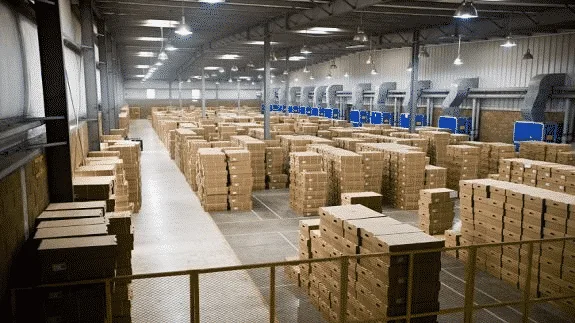
When buying LED lights, have you ever seen the terms “Class I,” “Class II,” or “Class III” on the product specifications or casing markings? Many people assume these refer to the light fixture’s brightness level or model number, but that’s not the case—they represent the light fixture’s safety rating against electric shock. This directly affects safety during use, especially when selecting lights for different applications such as engineering, outdoor, and home use. Choosing the correct rating is crucial to avoiding the risk of electric shock.

Why are LED lighting fixtures classified into Class I, II, and III?
LED lights are electrical products containing live components (chips, drivers, etc.). If insulation fails or the design is flawed, the casing may become electrified, leading to electric shock. Different scenarios involve varying usage environments, contact frequencies, and installation methods, resulting in different requirements for electric shock protection.
The Class I, II, and III classifications essentially differ in their “methods of protection against electric shock”—simply put, how the light fixture prevents people from touching live components and getting an electric shock. There is no inherent “good” or “bad” among the three; they only differ in their suitability for different scenarios. Choosing the right one ensures maximum safety.
1. Class I LED light luminaires: Grounding is essential for safety.
Class I is the most common safety level and the most frequently used type in engineering and industrial scenarios. Its core keywords are: basic insulation + forced grounding.
Theory
The live components inside the LED light fixture (such as the driver and terminals) are covered with “basic insulation” (a layer of insulating material). Simultaneously, all accessible metal parts of the fixture (such as the metal casing, bracket, and heat sink) are connected to the “protective earth conductor (PE wire)” of the power supply line—what we commonly call the “ground wire.”
Under normal circumstances, the basic insulation isolates the live components. If the insulation is damaged (e.g., by aging wires or a damaged casing), the fault current will be quickly discharged through the ground wire, simultaneously triggering the circuit breaker and residual current device (RCD) in the home to trip, preventing the casing from becoming live and thus protecting people from electric shock.
Feature
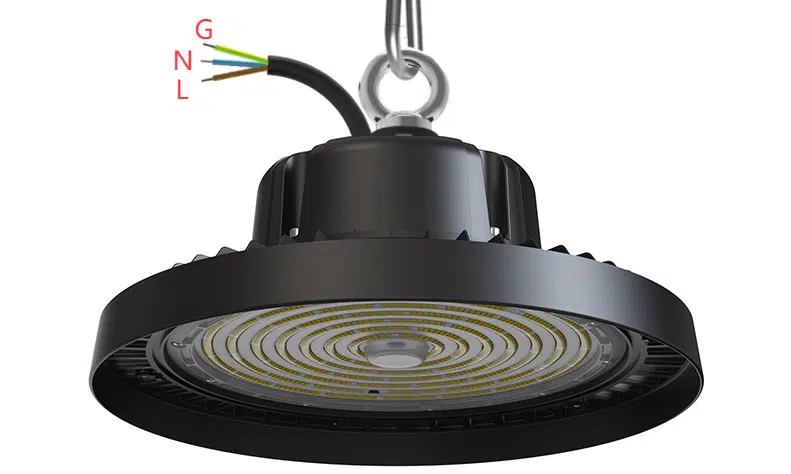
- Must include a three-core power cord (live wire L, neutral wire N, ground wire PE) and a three-prong plug;
- The light fixture itself will have a grounding symbol (⏚), and some will be directly marked “Class I” or “Ⅰ”;
- High-power LED lights with metal casings are generally Class I (e.g., outdoor floodlights, LED high bay lights, streetlights).
Application
Industrial plants, outdoor lighting (streetlights, courtyard lights), commercial spaces (shopping mall ceiling lights) – high-power metal lighting fixtures – in these scenarios, the fixtures may be touched, and the environment is complex (humid, dusty). Grounding protection can minimize the risk of electric shock.
Attention
Class I luminaires must be grounded! If there is no grounding wire during installation, or if the grounding wire has poor contact, the casing will become live if the insulation fails, posing an extremely high risk of electric shock. Many safety hazards on construction sites are due to Class I LED luminaires that are not properly grounded.
2. Class II luminaires: Protect against electric shock through “double insulation”.
Class II is the mainstream grade for low-power LED lighting fixtures in residential and commercial applications. Key features include: double insulation/reinforced insulation, and no grounding required.
Theory
It doesn’t rely on grounding protection, but instead ensures safety through “double insulation”—simply put, live parts are wrapped in two layers of insulation material (such as internal insulation + outer shell insulation), or with a layer of “reinforced insulation” (thickness and strength far exceeding basic insulation). This double protection means that even if one layer of insulation breaks, the other layer can still isolate live parts, preventing electric shock.
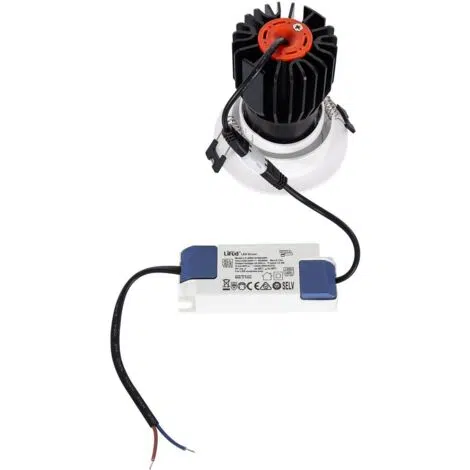
Because of this double protection, Class II luminaires do not require grounding and do not have a three-prong plug; they typically use a two-core power cord.
Feature
- The light fixture will have a “⎔” symbol, which is a Class II identifier and is more common than the words “Class II”;
- No grounding is required; it uses a two-prong plug and is usually more compact.
Application
LED Household lighting fixtures (LED ceiling lights, table lamps, wall lamps), handheld lighting fixtures (flashlights, portable LED lights), and small commercial lighting fixtures (LED downlights, LED panel lights) – in these scenarios, the lighting fixtures are frequently touched and installed close to people. Double insulation can avoid the risks caused by improper grounding and allows for more flexible use.
Attention
Class II luminaires must not be grounded! Their design does not rely on grounding; forcibly grounding them may damage the insulation structure and create safety hazards. Furthermore, do not disassemble the luminaires arbitrarily to avoid damaging the double insulation layer.
Why are so many aluminum-cased downlights now classified as Class II?
Many people may wonder why so many aluminum-cased downlights are now Class II. After all, aluminum is a metal, and according to the previous statement that “metal casings are mostly Class I,” this seems contradictory. However, it’s actually a design upgrade to Class II combined with the usage scenarios required for aluminum-cased downlights. There are three core reasons, which are easy to understand:
- Standards allow metal casings to be Class II: Many people mistakenly believe that Class II can only be plastic casings. In fact, the international standard (IEC/EN 60598-1) clearly stipulates that Class II luminaires can be divided into metal-cased and insulated-cased types. As long as the metal casing has proper double insulation or reinforced insulation, it can meet the Class II safety requirements. It is not necessary for a metal casing to be Class I.
- The core function of the aluminum casing is heat dissipation, not conductive protection: Aluminum-cased downlights use aluminum primarily to address LED chip overheating and extend lamp life due to its high thermal conductivity, rather than relying on grounding for protection as a conductive component. The internal live parts (driver, terminals) are double-insulated, completely isolating the aluminum casing from these live parts. Even if the aluminum casing is touched, there is no risk of electric shock, fully meeting the core requirements of Class II “double insulation/reinforced insulation.”
- Suitable for both residential and commercial areas, aluminum-cased downlights are primarily used in dry environments, such as homes, shopping malls, and office lighting. In these settings, many older buildings and ceiling wiring lack grounding. If Class I (forced grounding) is used, inadequate grounding can pose safety hazards. Class II design eliminates the need for grounding, ensuring safety through double insulation while avoiding the risks of improper grounding. The aluminum casing’s aesthetics and heat-dissipation advantages are also retained, enabling more flexible installation and reducing grounding-related construction costs.
In short, Aluminum-cased downlights are a combination of “metal casing + double insulation”. Aluminum is used to solve heat dissipation, and double insulation is used to replace grounding, which perfectly meets the needs of home/commercial scenarios. This is also the core reason why it is classified as Class II.
3. Class III LED luminaires: Relying on “low voltage” to prevent electric shock at the source.
Class III is the safest class, with the core keywords being Safety Extra Low Voltage (SELV), which requires no grounding.
Theory
Its power supply voltage is strictly controlled within the “safe extra-low voltage” range—international standards stipulate that SELV voltage ≤ 50V DC. This voltage level is harmless to the human body, and even direct contact with live parts will not result in electric shock.
Class III LED lights (Low Voltage LED lights) do not contain high-voltage components and require a dedicated step-down power supply (such as a 36V or 24V driver). The input voltage is low, and the output voltage is also low, eliminating the risk of electric shock at the source.
Feature
- Must be used with a dedicated low-voltage driver, with a power supply voltage ≤50V DC (commonly 36V, 24V);
- No grounding required, suitable for environments with high human contact and humidity, many LED landscape lights are Class III.
Application
Low-voltage light strips, 48V smart magnetic track light, underwater lights (LED fountain lights, LED pool lights), low-voltage LED floodlights in mines/tunnels, and airport navigation lights—in these scenarios, people are likely to come into contact with the lights, or the environment is humid, and a low-voltage power supply can ensure safety to the greatest extent.
Attention
Class III LED light luminaires must use a compliant low-voltage driver and cannot be directly connected to a 220V high-voltage power supply; doing so compromises safety protection, causing electric shock or damage to the luminaire.
How to select the suitable Class rating for LED lights?
- For residential/indoor commercial lighting applications: Class II is the preferred choice, as it eliminates the need for grounding, is easy to install, and provides sufficient safety.
- For engineering/outdoor applications: Class I (metal casing, grounding) is suitable for most outdoor lights and industrial/mining lights; for wet or water-related applications (swimming pools, fountains), Class III (low-voltage) is the preferred choice to prevent electric shock at the source.
Conclusion
The Class I, II, and III classifications of LED lighting fixtures differ in their “electric shock protection methods”: Class I relies on grounding, Class II relies on double insulation, and Class III relies on low voltage. There is no best class, only the most suitable scenario—choosing the right class can ensure safety and avoid unnecessary cost waste (for example, Class III LED lighting fixtures do not require additional grounding, saving installation costs).

Hello, customers
My name is Ricky Wang, I’m the business manager of GRNLED. I have been in LED lights industry for more than 10 year. Feel free to contact us. I’m happy to provide you the best service and products.
Email: info@grnled.com | WeChat: ledfixture